How to give your AI real context about your business, without making it Tom's job
November 6, 2026
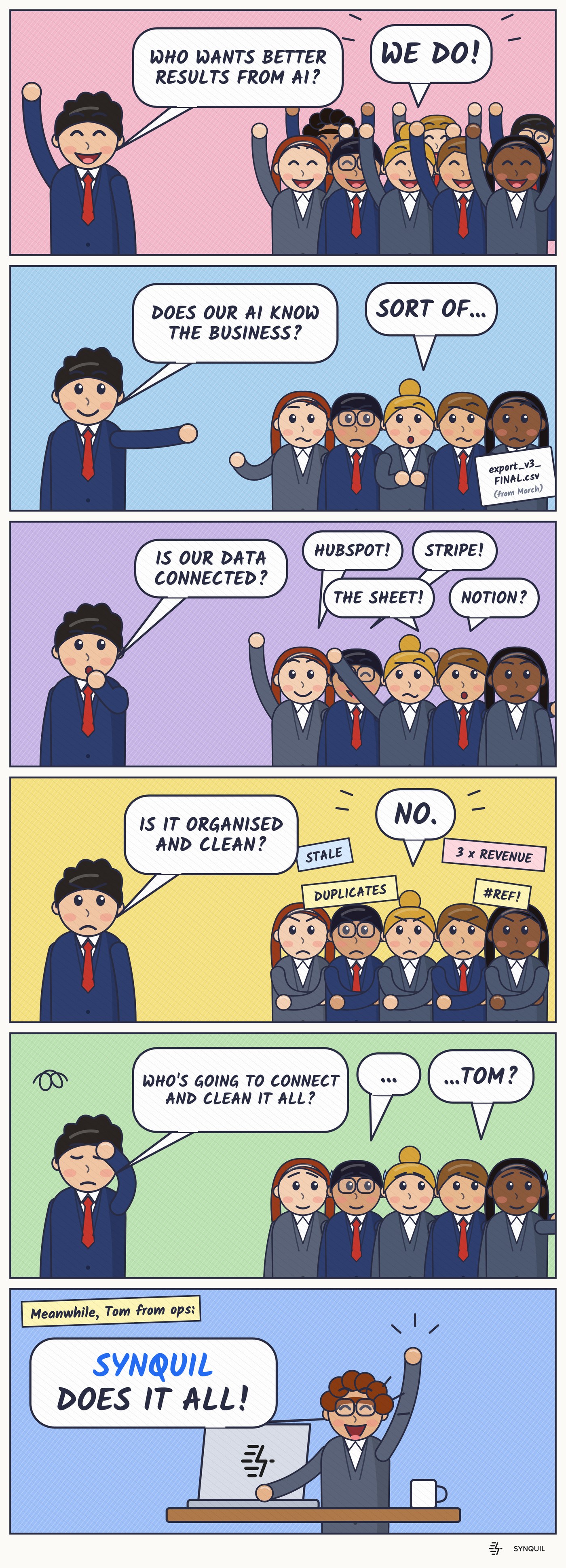
In most of the companies we talk to, the meeting goes the same way. Who wants better results from AI? Everyone. Does our AI know the business? Sort of: someone pasted in an export from March. Is our data connected? It's in HubSpot, Stripe, a shared spreadsheet and probably Notion. Is it organised and clean? No.
Then someone asks who is going to connect and clean it all. There's a long pause, and eventually someone says: Tom?
 Every company of 20 to 100 people has a Tom.
Tom is whoever sits closest to the data and is least likely to say no: the ops lead, the one analyst, or the founder who knows some SQL. Tom already has a full-time job.
TL;DR: Better AI results come from business context, not from a better model. That means your data connected across tools, cleaned into one consistent shape and kept current. Without a data team, that work lands on one person as a chore that never ends. It should be infrastructure instead: connect each tool once, let the data consolidate and sync on its own, and have every AI tool read the same picture, with each person seeing only their own slice.
Why do AI answers about your business stay vague?
The model isn't the bottleneck. Claude and ChatGPT reason well. They just can't see your business. When a team says its AI "sort of" has context, it usually means one of three things: an export pasted into a chat (out of date the next morning), a built-in connector to one tool, or whatever the assistant remembers from earlier conversations.
Each of those is a partial view. Ask "which customers are at risk this quarter?" and a good answer needs CRM activity, billing history and support tickets at the same time. Business context comes from how your data is set up, not from how the prompt is worded.
The context is in your tools, just not in one place
Ask where the data lives and everyone points somewhere different, and each of them is right. Sales is right about HubSpot. Finance is right about Stripe. The spreadsheet holds the targets nobody put anywhere else. Each tool is accurate about its own slice and knows nothing about the others.
So one customer exists four times, under four IDs. A question like "why did this customer churn?" spans five tools. Connect AI to each tool separately and it gets four partial views, with no way of knowing they all describe the same customer. Connect a tool to AI and it sees everything in that tool, and nothing in the others.
Is it organised and clean? Usually not, and the AI can't tell
The mess is ordinary. The same customer appears twice. Revenue is a number in one tool and text in another. A column called "Status" means three different things across three tools. Last quarter's export sits next to this quarter's. A person notices these things. An AI answers confidently either way.
Clean data, for AI, means one consistent shape: each customer is one record, numbers are stored as numbers and dates as dates, and every AI tool reads the same version. Without that, two AI tools give two different numbers for last month's revenue, and neither of them is wrong about the data it was given. We've written about cleaning in detail here.
Why it always lands on Tom
A 30-person company has no data team, so this becomes nobody's job, which in practice makes it Tom's. And it isn't a project with an end date. It's a chore: an export every Monday, pasting it into a chat again, rewiring each new AI tool, fixing the formula that broke. It never finishes, because the data changes every day.
So Tom turns into the integration layer, by hand. The comic is funny because the team's answer to "who will fix it?" is a person. A better answer is a piece of infrastructure.
What "Synquil does it all" actually means
Tom's line is a punchline. Taken literally, it means this: Synquil is the AI data infrastructure that sits underneath the AI tools your team already uses.
- Connect. Read-only connections to Google Sheets, HubSpot, Stripe, Notion, Jira, Linear, GitHub, Pipedrive, your own Postgres or MySQL database, and CSV uploads, with more sources on request. It takes about 10 minutes from connecting a source to having a live schema, and nobody has to change how they work.
- Organise and clean. Synquil drafts one connected schema across your sources. Names and types are made consistent, duplicates are removed, and the same customer is merged wherever the tools share a key such as an email address or an ID. Synquil measures how well tables join across sources and leaves weak joins out of answers. Tom reviews the draft before it goes live.
- Stay current. Scheduled syncs (daily on Free, hourly on Team) pull in changes on their own. No more Monday exports.
- Serve every AI tool. Claude, ChatGPT, Cursor and Windsurf all read the same layer, so the same question gets the same number.
- Control who sees what. On the Team plan, each person's AI sees only what they've been granted, down to the column. Anything not granted is invisible to them, not just refused. Here's how the access model works.
"Does it all" has limits, and we'd rather name them. Synquil merges records on shared keys, not on names that look similar, so "Acme Inc" and "ACME" with no email or ID in common stay two customers today. It doesn't apply custom validation rules or convert currencies yet. It reads from your tools and never writes back to them. Tom still has a job: approving the schema and deciding who sees what. That takes minutes, not every Monday morning.
When you don't need this
If it's one person and one spreadsheet, paste the spreadsheet into a chat. This becomes worth doing when the answers you need span several tools, or when more than one person on your team uses AI on company data.
Better AI results don't come from a model upgrade. They come from business context: connected, clean and current. That can be one person's job or it can be infrastructure, and Tom would rather it was infrastructure. AI needs context. Businesses need control.
Connect your first source free, no card needed, at synquil.com.